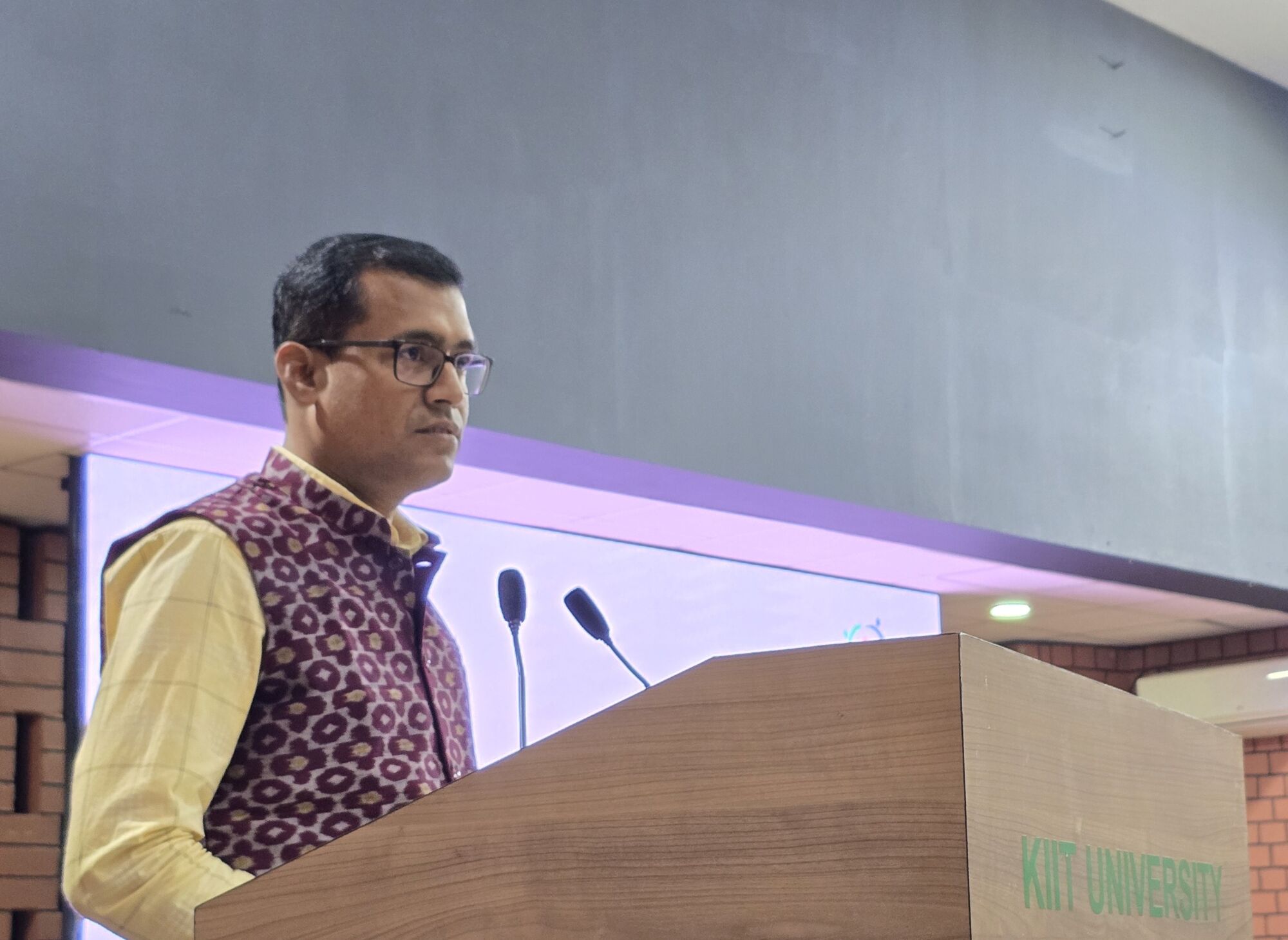
The session offered a deep and critical understanding of the gaps between planning frameworks and actual development outcomes at the grassroots level in India.
He began the session by explaining the concept of local planning and its intended role in empowering communities through decentralized governance. He highlighted the constitutional vision behind local self-governance, emphasizing the roles of Union, State, and Local Governments, and how ideally these institutions should work in coordination to achieve inclusive development. He encouraged students to question “who plans and who truly benefits”, prompting critical thinking around participatory development.
The session shed light on key contradictions within India’s planning system, such as the Function–Fund–Functionary gap, planning versus scheme-driven implementation, and the dominance of parallel governance structures. Using data points and real-world examples, he explained how local bodies are often empowered on paper but constrained in practice due to limited financial autonomy, inadequate technical capacity, and upward accountability of officials rather than accountability to local communities.
He also discussed issues related to participation versus tokenism, uneven devolution of powers, capacity constraints of local institutions, and poor convergence between development schemes. He highlighted how local aspirations often clash with national and state priorities, leading to development that is less place-specific and more target-driven.
Concluding the session, he outlined a clear way forward by emphasizing genuine devolution of the 3Fs – Functions, Funds, and Functionaries, strengthening Gram Sabhas and ward committees, enhancing technical and administrative capacity at the local level, and promoting convergence-based, area-specific planning. The session was insightful and thought-provoking, leaving students with a stronger understanding of grassroots governance and the need for accountable, participatory, and outcome-oriented local development in India.